....where I seem to be interested in sports this week

Wednesday, 19 November 2014

Thanksgiving wines: Oregon Pinot Noir

Originally wrote this for Canadian thanksgiving, but can work as well on an American thanksgiving table. I realize with some six feet of snow on the ground in parts of the Great Lakes and Northeast this week, it's not precisely autumnal anymore...

The Willamette Valley


Pinot in general is I think a good shoulder season bottle, but there is a certain earthiness to the Oregon wines that I think fit nicely around thanksgiving. Pinot Noir is traditionally regarded as amongst the most challenging wine grapes to flourish, much less perfect. This mostly has to do with the grape skin's delicate nature and the exacting conditions the resulting juice requires to thrive. As far as red grapes go it is just about the opposite of the hardy sun-loving plant-all grapes like Shiraz and Cabernet Sauvignon that practically appear in every wine growing nation on earth.

Indeed it was long conjectured that Pinot's homeland of Burgundy would never face a serious challenger like Bordeaux has seen with Napa. The prices of the top drawer red burgundies from the Cote d'Or may not be touched but the last couple decades has seen upstart colonies in New Zealand and Oregon demonstrate the French monopoly on quality Pinot Noir is well over.

Next comes the cost difficulty. Pinot Noir has never been cheap, and that is just a fact of the high value estates it can be grown in and the meticulousness that it's harvesting requires. The usual low bar for a decent expression of Pinot is around £12 or $20 CAN. The one fantastic exception to this rule is a wine I've trumpeted for years and that's Cono Sur bicicleta Pinot Noir from Chile, which is widely available with it's distinctive lavender coloured twist off cap for £7 or $12 CAN.

I should mention a note on the taste of Pinot. For those accustomed to rather rich, fruit driven everyday wines from, say, the Languedoc or Australia, Pinot can come as a bit of a surprise. It's a bit like the difference between a filet mignon and a t-bone steak. The one more delicate and perhaps exquisite on the tastesbuds, the other hearty and juicy. I know well seasoned wine drinkers who simply don't comprehend the lingering cherry bite of a Pinot, as if it's an entirely different drink than the Cab and Shiraz they're used to. But I digress.

In the lexicon of wonderful archaic descriptions that are associated with the nose (ie. smell) of certain wines, a classic is 'barnyard' with red burgundy. Whether it specifies whether's it meant to be the domicile of cattle or horses, I'm not sure, but it does speak to that earthy quality that can be present in Pinot.

The Willamette Valley south of Portland was the end of the line for American settlers going back to the days of the Oregon trail itself, but it wasn't until the 1960's that world class wine operations began to take shape. It was noted in those days that the climate was more similar to that of Burgundy than anything found further south in California. Since then the number of wineries in the valley focusing their production on Pinor Noir has mushroomed.


 Erath, founded in 1972, was a vineyard I visited on one of my trips to Portland, as it lies just south of the city near the head of the Willamette Valley. It's range of Pinot Noir's have long rated well, and it's principal wine is one of the only Oregon Pinot's reguarly on offer in Ontario at least.

Apparently it's sold by the can in Oregon... allowing for It's Always Sunny in Philadephia induced wild gesticulating during conversation while drinking wine


Underwood Oregon Pinot Noir, availbale in the UK at Marks & Spencer is award winning and at the respectable price of £13. As for a thanksgiving meal, I very much like the pairing of Pinot with turkey and lightish gravy since the wine shouldn't overpower the various flavours combined together in a classic full dinner. For that Oregon Pinot likely represents much better value for money than an average burgundy.

Sartorials: Thoughts on Walking Out the Door in the Morning

I was reminded recently in a ribbing manner of Jack Donaghy's line to Liz Lemon when dressed in a tuxedo for no apparent reason, "it's after 6, what am I a farmer?" It also made me a recall a similar statement I had answered years ago, when queried on my habit of donning a suit, or at least a waistcoat and tie. "I'm a man. How else would I walk out the front door in the morning?"

I've been in London now for a couple of years, and have had the chance to observe that, in the main, it is the best male dressed city that I have spent time in. By comparison Rome was embarassingly shabby despite Italian's elegant reputation.

Here, therefore, is a handful of axioms in some semblance of order from the ground up.

Shoes: As long as you find yourself in some line of work that is not a funeral home director or an underling in high finance where you're expected to sleep at your desk in your uniform navy drabs, there is no reason to not occasionally be wearing brown dress shoes. They punch up any suit, including navy ones, and especially grey ones. In fact, except for the theatre, the only time I tend to wear classic black lace ups is with a brown suit, to once again draw the eye to the whole ensemble.

The bolder one's persona/ latitude of one's employer's the lighter one can go with the brown shoes. Additionally tied into that is the lightness of the grey/blue suit, and finally the summer, clearly, is a more fitting time to go with lighter shades. Ultimately, when in doubt look for a chocolate brown.

A Matter of Fit:
So now that you've got your spiffy brogues, please for the love of god, hem your trousers properly. Potentially my biggest complaint of men who don't know how to dress is ill-fitting trousers. When standing, the base of the pant leg should just obsure the socks, touching the top of the shoe tongue and laces. It should not pool or otherwise bunch around your ankles. When seated with a leg crossed it is perfectly acceptable, indeed encouraged to show some of your sock, and thus why men's dress socks are sneakily the best way personalize a look even if stuck in an otherwise plain office attire

Socks: the classic dictum for colour is to go for a shade somewhere between your trousers and shoes. So for blue suit, black shoes, a dark grey is good. For blue to brown, I like a lighter blue or darker brown. That said, arbitrary colour and/or pattern is definitely in vogue. You can throw just about anything on, and I'd say as long as it doesn't look like either you're trying too hard, or just downright bizarre, go for it.

Belts: Another vexatious issue. For some reason many young men believe it as an indispensible item in a formal suit. It is completely not. Indeed, if you don't actually require a belt to hold up your pants, you probably shouldn't be wearing one. The greatest strengths of the visual look of a two piece suit are clean lines and symmetry, and this gets needlessly broken up with a shiny belt buckle. This even includes suit trousers with belt loops. They look totally fine empty, and again, contribute to the clean look of a suit on a reasonably in shape man.

That said, one scenario where I think a good belt can help the look is with a non matching jacket- trousers combination. Here, like the socks, the colour of a belt can transition between the two. Definitely for instance with jeans and a jacket. Finally, yes dictum says your belt and shoes should match in colour, and I would typically agree, though it's not an ironclad rule.

What to look for in a jacket: The biggest trend in the last decade, in no small part thanks to the late 50's-early 60's aesthetic of Mad Men has been the slimming of suits, eliminating the boxy three button jackets of the 90's. Unless you're shopping at Sears or a provincial Marks & Spencer, three button jackets, that is to say cut higher on the chest, are completely out of style.

A note on doing up buttons: only do up the top button of a two button jacket, or the middle one on a three button, followed in preferance by the top two.  Do not do up the bottom button on a jacket, especially when sitting, otherwise you look like an idiot.

What else? Much like the trousers, men tend to buy suit jackets not only too large, but often, too long. When standing, you should be able to easily cup your fingers underneath the base of the jacket. If your fingers are just touching the bottom of it, it's too long. Similarly on the cuff, the sleeve should just barely reach to the wrist, and certainly not encompass it, thus allowing to show about a centimetre of shirt at the wrist.

On ties: Generally one's tie width should aim to match the width of the jacket lapel at it's widest point. Most average width ties and average lapelled jackets fit this fine without anyone putting any thought to it. Particularly fat ties can still look acceptable with an average jacket, but skinny ties look lost with a wide lapelled jacket and torpedo the whole look.

Same for knots. Mid sized four in hand (that is, regular) tie knots look fine with average collars. A skinny tie looks ridiculous with a spread collar. But unless you're a banker, or the recently employed David Moyes, you likely don't have too many spread collar shirts.
If you've stuck with me for this long, here comes the payoff. The one, unbreakable rule for a man to dress properly. Your tie must be darker than your shirt. Repeat that sentence.

Thus why a white shirt, a la the Mad Men era is in fact the most versatile look because it allows basically any combination for a tie and suit.

Bonus second unbreakable sartorial dictum: DO NOT wear a backpack/knapsack with a suit. A backpack with a suit makes you look like a high school student at a university open house day. I don't care if you cycle to work. Hipsters have Messenger bags for a reason. I don't care if you've come off a plane, carry a Fred Perryesque duffel bag.

Travels in Austro-Hungary: Vienna


If Budapest felt like we were at times on our way to some rendezvous with an operative out of a John le Carre novel, Vienna was distinctive and all the same appealing. The Magyar capital seemed post-war; first or second, take your pick. Vienna resounded with an imperial belle epoch neo-renaissance glitz. The huge palaces, the artfully conceived ring strasse and pretty public gardens all felt destined to echo and hum with the clip-clop of handsome cabs and the rustling of vintage trams.

First impressions were rather less ebullient as we ascended the steps from the u-bahn into the uncomfortable bustle of Stephensdom Platz and the main tourist drag. Further wandering however led us to the elegant shopping quarters and the impressive grand buildings lining the ringstrasse. These included the Parliament, the Opera, and state museums, to speak nothing of the imperial residences. I particularly liked the story of why the Vienna town hall is arguably the grandest of the civic architecture for the fact that after decades of imperial direction on renovating the cityscape, the commerical burghers of the city decided that enough was enough of visibly playing second fiddle in their own front yard.

Continually finding pleasant pockets of streets slightly away from the Cathedral hub, this most livable of cities (as meaured by the Economist) reminded me as a sort of cross of the proud bourgeios architecture of Amsterdam and the limestone faced Catholic churches and cafe culture of Rome.

Speaking of the coffee, I did adore the antention to detail and civility of the newspaper strewn proper coffee houses (not like Amsterdam there). At the locally popular Cafe Pruckel we sat outside in the late afternoon along the eastern side of the Ringstrasse. I had a glass of wine, while most of the local patrons partook in wine spritzers.

The next morning at the Cafe Museum near the Opera we enjoyed a nice cup of americano though I would later read the decor of plush red velvet booths had recently been modifed from the cafe's more workaday appearance in the fin d'siecle.

Of palaces, we took in the grounds of the Belvedere and Schonbronn, and disappointingly touring the state rooms of the Hofburg. My thinking was along the lines of "these are just a series of unrelated rooms with, quite frankly, drab furniture and fittings organized around various colours... I saw this at the White House when I was like 9."

Ah, Vienna


Perhaps the highlight of attempting to investigate the local area around the Belvedere was finding ourselves in ordinary working class south eastern Vienna, myself obviously wearing jacket and tie, since I thought I was visiting a palace. We were rebuffed at one dive bar that was in the guide book as a decent local coffee house, before shuffling into a crossroads tavern bar, It was full on Alpine with the wooden booths, frumpy hostess, good beer and tasty schnitzel. I even proudly recall I managed a couple utterly rudimentary sentences in German, with the Bavarian return prego I remember as bitteschon.

Naturally, I get very excited about the chance to imbibe truly locale tipples. So it was for Vienna and Gruner Veltliner (as I would learn pronounced velt-leener). In a worldwide scene dominated by the likes of Chardonnay and Sauvignon Blanc, it is intriguing to me the modest success story of a grape like Gruner. It is almost entirely grown only within the wine regions near the Danube in eastern Austria. It is typically a light-ish white that is perhaps more pleasant than it is distinctive and thus is well suited as an aperitif or pairing with food.

After a couple Gruner's at a hipstery kind of bar near the museums, we returned across town to the hotel for a regroup, where, with my proverbial tail up, I knocked about the Spar supermarket up the street for another bottle of the local white Veltliner.

Making a night of it, just off Schweden Platz we remembered a well lit, small wine bar that we had ventured past the first evening immediately across, handily, from the Canadian embassy on Laurenzerberg.

We wandered in and pulled up a stool at the counter and began to converse with the jovial proprietor, Roland. Turns out he had just opened the joint barely a fortnight ago, sinking his savings into his dream of running a wine bar, in part focusing on locally produced stuff. He had even roped his wife into service that night as she was, to her chagrin, on summer holiday from a desk job in their nearby provincial town.

Laughing and chatting with Roland, the glasses kept being topped up with various Austrian Gruner's and Rieslings and even some South African rose bubbly he had picked up on a golfing trip and had opened the previous evening. Before long a cured leg of ham was produced and we ended up helping Roland and his wife close up the joint.

Finally, we tread the well worn path to the Cafe Central, replete with its fluted interior where in the years before the First World War one might have come across Sigmund Freud or Adolf Hitler on any given day. Unfortunatey the grand old cafe of the city does a brisk tourist trade. Maybe it's always been the case, but the table next to us was a couple of frat boys in Florida State t-shirts- at least they'd gotten out of bed before midday. Much worse was the bloke in cargo shorts, blond surfer hair and flip flops who walked in, browsed the confectionary counter, and then turned around and took a selfie with one of hand held poles. 5-2 he was Aussie? Plus, the coffee was rubbish.

Our last evening in the city we grabbed a beer along the main canal, similar to the pop-up cocktail bars in summer along the Tiber embankments in Rome. It was a relaxed setting watching the joggers and after-work amblers. If I could speak more than two sentences of German I even mused I could imagine myself in a city like Vienna. A coffee, Gruner Veltliner and Palace infused culmination of a universiy wine buddy and I's week in the Habsburg capitals.

Travels in Austro-Hungary: Budapest


I was booked on something called 'Wizz Air'. Once upon a time all airlines tended to have stolid, upstanding names: British Airways, Air Canada, Continental. Then there's EasyJet and Ryan Air (invariably announced over the intercom, in the moments when trumpets aren't blaring, with that conspiratorial culchie accent that seems to make it all the more grating).  Now I'm on Wizz Air. Which, frankly, all sounds a bit slipshod.

On the positive, they have a uniformly hot team of, presumably Hungarian, stewardesses well used to the baiting of the English stags, or in the case of a few rows in front of me, a mid-fifties lads weekend to Budapest.

Earlier, amongst the seventeen page clicks it had taken me to purchase my flight, I had opted for the airline's express shuttle bus from the airport for four euro; reasoning that represented a good piece of business, despite not altogether being certain where it was delivering me to.

I was flying out of Luton, my least favourite London entrepot (extrepot? Can we get a ruling on that? Also, Stansted can't believe it's luck after that last sentence.) Naturally the plane was delayed by over an hour, leaving me some fourteen minutes from touching down in Budapest to my appointed bus rendezvous. This being random Europe, I made it with time to spare.

Standing alone in the quiet of long term parking, an unmarked white van pulled up at speed, with a young man throwing open the sliding door "You Muncaster?" Well, that didn't actually happen, but would have been cool. Instead I wordlessly pointed to my single name on a clipboard and we sped off again to destinations unknown. (I presumed he would drop me at the train station or something, and wasn't too worried about it. One of these trips I'm definitely going to find myself in the wrong unmarked van, but I digress.)

Dropped off at a bustling modern traffic square in Pest I went in search of some cobblestone streets and a leisurely stroll in the humid Friday August evening for my scheduled 8pm glass of red in the Mercure hotel lobby bar with my old university buddy and wine confrere Eric.

That first evening we found a lovely street in the university district on a neo-classical piazza for some al fresco dining and Staropramen. Day one found us exploring the Royal quarter on the Buda side of the Danube; ascending the citadel via the Grand Budapest Hotel-esque funicular, drawing laughs of comparison to the similar gondola utilized in the Ralph Fiennes film.


After lunch I was delighted to learn from the guide book that there was an establishment nearby labelled 'Domus Vinum Magiarum'. Not least because I feel Latin really ought to be used as a lingua franca more often. It was billed as a wine and cicchetti bar sponsored by the Hungarian wine authorities specifically for promulgation of their country's home products. So you've got a couple of veteran wine geeks actively looking to be impressed by their nation's offering, and on a thirsty, sunny Saturday afternoon the House of Hungarian Wine is shuttered up closed.

Crestfallen, I had to make do with getting out of the baking sun by checking out some nearby catacombs that spuriously claimed to be the holding dungeon of Count Dracula. Furthermore, I thought Hungarian wine might have missed its best shot to impress me. Happily I was to be proven incorrect on that score.

As day turned to evening, we found Budapest strangely quiet. I wasn't even convinced it was the old carte blanche August holiday of grand French or Italian tradition. After all, there weren't any hastily scotch-taped, pen scribed 'closed' signs across the multitude of shuttered joints.

Irrespective, it was a grand town, and sufficiently John Le Carre-esque enough vibe for the Euro-trotting Eric and I to bask in. One morning's coffee was taken at a cafe situated in a 19th century apartment block courtyard. The euro police siren echoed from the busy thouroughfare; a couple of cute college aged girls with potentially American accents laughed and took photos the next table over. Instinctively and humourously, Eric and I lean in, take on Kim Philby- Cambridge Five toff accents, and wonder "Could Langley be on to us!?" Funny thing, twenty five years ago you would have probably been shot or at least suspiciously gulaged for joking about such stuff in that city.

That evening, finding the town bizarrely demure for a browse of restaurants and bars, we settled on investigating a restaurant with a highlighted wine menu that I had noted in the guide book. Called Borbirosag, it was located on another empty, non-descript square in the south end of Pest and turned out to be one of the memorable restaurants of my whole life.


It's about half full on this balmy Saturday night in August and we get an outside table. The service is immediately friendly, intimate, and knowledgeable. Their wine list is a thing of beauty. Some two hundred wines available by the glass, and all of them Hungarian! The actual menu wasn't a trifle either as we both enjoyed wonderful meals.

I'm not a food porn kind of guy, so I basically recall that Eric had a whole white fish, possibly pan fried, that came apart beautifully. I had a tenderloin of beef alongside the Hungarian foie gras equivalent that's a local favourite.

What impressed me most with the Hungarian wine was it's breadth. Encompassing a range of well known varietals, both red and white, in addition to their own homegrown niche grapes. They might not have the mass scale export capability of a Chile or South Africa, but compared to Canadian wine, say, they left us stone dead, and all with enticing prices; at least there in the Hungarian Forint.

Both nights (we ended up returning for round two on our last night it was so memorable) we naturally started with white before moving onto red either with dinner or the cheese course.

My favourite white was a Furmint, the local grape grown historically for Tokaj, the famous sweet wine of centuries gone by. This dry offering, from the village of Mad in north-eastern Hungary (I'm sure there's an accent in there over the 'a' but not sure which one, or how my computer does it) was crisp and yet full of flavour. Somewhere between a cleaner Sauvignon Blanc and a fruitier Pinot Grigio.

Next we had a couple gorgeous reds from the Ikon vineyard situated around Lake Balaton, a resort area not far from Budapest. Their 'Evangelista' offering is 100% Cabernet Franc (always one of my favourite grapes) and retails around £11 if you can find it in the UK, which I would happily pay. The rarer 'Tulipan' bottling is a bordeaux blend, and regarded as a top notch Hungarian wine.

Our waiter was a young man and did yeoman's service in shepherding us through the pages of the exhaustive wine list, which was fantastically interesting for it's inherent foreignness. The second visit, the food was just as good, but a couple times I was left feeling average on the staff's wine calls, asking more than once for something "closer to what I had last time".

Ultimately, having an all round jolly time and deciding to proverbially push the boat out on the Hungarian Forint, I simply asked as the waitress, "what is the best red wine you have?" I can assure you I've never done that at a restaurant before, nor unlikely will again in most conceivable circumstances.

I was brought a glass of 2009 St. Andrea 'Merengo' from Eger region, and it was a fascinating blend of 40% Merlot, 33% Kekfrankos (whatever the hell that is), 20% Cabernet Franc, with a bit of Syrah and Pinot Noir. Maybe it was just me at the end of another lovely meal, but it was everything a young but brilliant claret wine should be like. Incredible length and succulent tannins. It was so good, I took another glass of it over a harder edged night cap.

I see online Jancis Robinson, the esteemable veteran British wine writer, has given this bottling only a B+ kind of grade, which does make me wonder: maybe it is all in the setting, and the ambiance, and the expectation to enjoy one's wine. By the way, with conversion, the glass of this amazing restaurant's best red wine cost about £8. About what you'd pay for a large glass of plonk in a Kensington pub.

the old tour guide in me


As for the rest of our site-seeing, naturally we had more history on the docket. First up was the largest synagogue in Europe, which upon entering is notable for its basilica like plan. What was especially moving was the adjoining cemetery, which was full of dates from the winter of '44-45. Spectacularly, not even needing transportation to the concentration camps, the vast majority of these poor souls had simply starved to death locked inside the streets of the Budapest ghetto.

Next, we travelled by commuter train to the northern hinterland of the city for a glimpse at archaic and repetitive Roman crap, which I adore. We found ourselves in the half decently preserved shin-high ruins of Aquincum, one of the remotest Roman civilian towns in the empire. The very limits of the province of Pannonia.

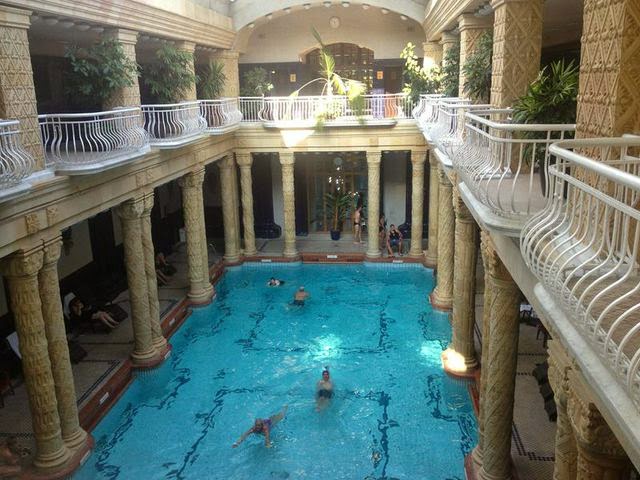
On our final day we toured the Hungarian Parliament in the morning, a building often regarded as one of the jewels of the Danube. Afterwards we hit up the thermal baths at the renowned Gellert Hotel on the Buda banks of the river.

Bathing suits in plastic bags, we manage a sortie into the side entrance of this grand edifice. It was kind of like entering a central national library and asking where we go swimming. Soaring vaults, marbled floors, and bronze statues greeted us as we paid our day pass.


We split our time between the hilarity of the Jude Law-ian Grand Budapest Hotel scenes in the main indoor pool, to chilling with a couple beers on the patio deck of the outdoor wave pool and massive hot tub. And to think we were situated in a veritable oasis in the middle of a large metropolis, was one of the coolest experiences of my life.

From the Keleti Station we boarded the train westbound and disembarked in the Habsburg capital, Wien.

Tuesday, 15 July 2014

Peter Lehmann of the Barossa

dry, dusty, and world class Shiraz


In honour of Germany bagging the World Cup this week, we take a look at the wines of a German-Australian icon and the terroir he helped make world famous.

For a lot of people Aussie wine means pretty much one thing: rich, spicy, vanilla laden Shiraz dominated reds available from all the big brands that appear on supermarket shelves everywhere. But beyond that are many interesting varietals, including Shiraz of course, from an almost bewildering plethora of wine growing valleys concentrated mainly in the south of the continent.

Investigating my dad's dwindling cellar several years ago for bottles that had slipped through the cracks we came across a couple Cab Sauvs and Chards from the late 80's from Margaret River in Western Australia. (Presumably the Chardonnay was well past its best before date)

This led us onto a conversation on the heritage of Australian wine. He said that even into the 1980's there was a persistent skepticism over the quality of the wine, first rate Penfold's Grange aside. Nowadays mass marketed plonk brought to life in barrel with floating oak chips (that's what gives it the intense vanilla flavour) can be more reminiscent of a coke can left open in the sun.

But on business trips down under beginning in the 70's my dad mentioned he was introduced to an emerging and dynamic viticulture as well in Australia. Cooler micro-climates could produce steely Rieslings or Cabernet Sauvignons with grip (two of my eternal favourites), while the warmer areas put together traditional southern Rhone blends of Grenache, Shiraz and Mourvedre. And if you need a cardinal rule, he said bringing the chat to a close, look for Peter Lehmann of the Barossa.


The first attempts at vine growing in the humid, sub tropical climes around the original penal colony at Botany Bay were hit and miss. It was in the 1840's that outlying vales around Adelaide and Melbourne were discovered to offer a promising destination to import European vines.

Young immigrant Englishmen were the first to establish reputations in the region, including a Tom Hardy (no, not that one) and Christopher Penfold. Not long afterwards the South Australia Company was formed to encourage agricultural immigration to this remote spot on the globe. Plucked from Silesia on the Prussian-Polish border, three ships of about 500 families of Lutheran dissenters set sail for the antipodes and this new group set up shop some 30 miles inland from Adelaide in the Barossa Valley.

A Lutheran church at sunset in the Barossa


Similar to Napa in California, the Barossa is amongst the hottest, most sunbaked wine growing regions in Australia. The Silesians, without any grape growing heritage of their own near enough the Baltic, nevertheless experimented with plantings of German Riesling; finding them successful in the sweet Rhenish tradition on the windier upper slopes of the valley.

It is on the lower slopes and the valley floor that Shiraz, as the northern Rhone Syrah grape has been termed, found a new home. For generations Shiraz of the Barossa lay effectively dormant. All Australia seemed good for was sun drenched alcoholic reds that were haphazardly blended into port like offerings.

An epic turning point occurred in 1950. Penfold's Max Schubert, born in the Barossa, a descendant of those Silesian pioneers, travelled to Bordeaux and came home with the idea of creating the southern hemisphere's only first growth. Choosing tantalizingly small plots of Shiraz around Christopher Penfold's original Grange cottage, he did the impossible, and created a wine to stand up to the best of left bank clarets.

Even after four years aging in bottles, the first offerings of 'Grange' were widely panned in the 50's. Little did anyone except for Schubert know, it was too young! Following decades would make Grange a cult wine, a recipient of over 50 gold medals at tastings and numerous perfect scores from wine publications. Indeed it is said those early 50's vintages are still improving in bottle.

The first vintage of Grange. Originally it included the appellation 'Hermitage' to refer to the Syrah of northern Rhone


Born in 1930, Peter Lehmann was a fifth generation Barossan, his father being the local Lutheran pastor. He began his career at the well known local Yalumba winery. Around 1980 he decided to strike out on his own and focus on catching a bit of the Grange magic in Barossa Shiraz. His company's logo of a card hand featuring the queen of clubs was based on the calculated gamble he felt he was taking.

35 years on and Peter Lehmann, nicknamed by his peers as the 'baron of Barossa' for his persistent championing of his home turf, is a by-word for the best of accessible Australian Shiraz. While his 'Stonewall' bottling (£37) is the firm's most prestigious. The 'Portrait' Shiraz (£10, $20 CAN) is a great example of the Barossa at a decent price.

My personal favourite, and one I lap up when I find it typically on sale in the States around $10 is his 'Clancy's Red'. A healthy Australian blend of Shiraz, Cabernet Sauvignon and a glug of Merlot, I think it's perfect as an everyday gift giving sort of wine. It's $18 at the LCBO, or £9 at Waitrose.


Put it next to one of those Yellow Tail's and there is no comparison. Not bad for some German Poles coming upon a sun baked patch of ground half the world away... it's no 16 goals in the World Cup though...

Thursday, 10 July 2014

Summer Wines: Asti


If you're ever in the mood to remind yourself, comparatively at least, that you're not an alcoholic, you can do worse than dusting off some Hemingway. In what is otherwise, frankly, a terribly sad novel, I recall with a smile coming across the opening salvos of Lt. Henry's tale in A Farewell to Arms. The first drink shared within the pages by the Tenente and his buddy in the officer's quarters behind the front lines in the Friulian Marches of WWI is a bottle of Asti. It is a nice moment of levity, encapsulated in what may well be the most easygoing wine in existence.

Asti is just great. It's deliciously aromatic, more-ishly sweet, low in alcohol (around 7%), and less bubbly than champagne or Cava. You can, quite legitimately, drink it all afternoon without succumbing to slurred discussions of politics or the many missteps of your favourite sports team. If I associate drier sparkling wines with celebratory toasts, Asti, I think, has a strong claim for the backyard, hanging out as the barbecue gets fired up. Buttoned opened in all the ways champagne is not, Asti can easily eschew fine glassware, and has a tradition of being glugged in pewter mugs that keeps the bubbles effervescent.

Asti comes from that eponymous region near Turin in the Piedmont (that also produces the red wine Barbera; of such incredibly varying quality that I rarely recommend it off the shelf, can be great though) from the Muscat white grape that crops up making both sweet and dry wines most places around the world.  The Martini & Rossi outfit, of vermouth fame (so famous that ordering a 'martini' in Italy gets you a glass of white vermouth rather than a gin based cocktail, much to my ongoing frustration) produces Asti in widely available industrial quantities. It's always produced non-vintage (that is, it doesn't bother to denote a year it comes from) so is ready to go off the shelf and a couple hours chilling anytime (it is best well and truly chilled, unlike say champagne that expresses itself better not ice cold).

The hill-top town of Asti, near Turin

The ubiquity of the Martini Asti brand is definitely a good jumping off point for checking out the wine. It's typically reasonably priced; about $14 in Canada or £6-8 in UK supermarkets. Though if you do have a wine shop that tends to know it's Italian stuff, I would say it's worth the trouble investigating a more artisinal offering at a slightly higher price point.

 Asti Spumante (as it used to formally be known; the sparkling adjective was apparently dropped for marketing reasons... or something) also has a sibling wine in Moscato d'Asti, which is of a different style, albeit delicious in its own right. It is extremely low in alcohol for a wine, around 5%, with only the slightest hint of bubbles to it, and is even sweeter. It's sometimes hard to find, but makes for a unique and interesting present as a desert wine.

My first stint in Italy was spent in winter in the central region of Abruzzo, and thus I didn't come across the quintessentially summer spumante of the north until my university days. My flat having a front porch rather than a backyard, I would wile away the spring term days between exams, reading or editing written work, with my trusty pewter tankard of fizzing Asti to quench the thirst. In summer days in Rome, it's pure drinkability when cold, led me to seek it out ahead of prosecco for picnics in the park. (Romanello, a moonshine equivalent made in the Alban hills, was taken for outings on the Via Appia)

The extraordinarily masculine setting of a requisitioned subaltern's room in the foothills of the Slovenian Alps, and the fact that Hemingway's avatar is drinking it at all, ought to dispel any notion that Asti, sweetness and all, is inherently a feminine wine. Much like a G&T, if the sun's out, there's no real valid argument against having a bottle of Asti on the go.

It's replication may be attempted elsewhere in the world, but the wonderful specifity of a bottle of Asti is one of the reasons it's denoted with DOCG status. That is, the most exacting standards of classifying a regional wine in Italy. Although DOCG status has been expanding in recent years to include, for instance, village level prosecco superiore, traditionally it has been reserved for Italy's most serious red wines.

The very fact, then, that light, fizzy Asti has been placed in the same category as Barolo or Amarone has rankled the occasional wine pundit; Hugh Johnson has called its DOCG status "questionable". What I cherish about it is its easygoing quality. In a world where so much wine takes itself seriously, and rightly so, Asti is the perfect wine to drink up without fuss and consultation. Bring it along to an afternoon backyard get-together, and tell anyone who sniffs at it to cop on and enjoy a summer's day.

Monday, 30 June 2014

Shakespeare's Sack


Delving more and more into the back story of wine I find it very interesting how our modern day experiences differ from past eras. Say you had to pick just one wine to serve at a function or get together, you'd probably go with a dry red table wine; pleasantly tasty but not too rich or fruity. A Cote du Rhone or Montepulciano d'Abruzzo.
Remarkably, for a lot wine history, this is precisely what no one would have expected. Instead, sweetish, sometimes fortified, white wine has held long periods of sway. I was surprised to find that Falernian, the premium Italian wine of the Ancient Roman aristocracy was in fact a richly aged sweet wine most akin to modern day madeira, rather than a juicy, tannic red that the mezzogiorno can produce so competently today.
While I profiled the popularity of claret in Britain last week, sweet German white wine from the Rhine Valley was also quite a popular import from the medieval period onward. The problem it shared with the earlier, lighter style of Bordeaux claret was that it didn't keep. Coopering technology wasn't airtight, so to speak, and so a consumer of wine was always looking for the freshest potation possible.
One style of wine that was easier to keep was higher alcohol sweet whites that tended to be produced in and around the Greek islands. Not only was this a long way to ship wine to England, but by the dawn of the age of exploration that part of the Mediterranean was under Ottoman dominion.

Up stepped the entrepreneurial Spanish Duke of Medina Sidonia. At the port of Saluncar, down river from Seville, he got rid of any export duty on local wines, and encouraged English merchants to establish premises in the town during the halcyon early days of Henry VIII's marriage to Catherine of Aragon. This wine, from the southern extremity of Christian Andalucia was known in Spanish specifically as an export item, or saco. The English rendered it as sack. Later generations, perhaps in an early bout of wine pontificating, attempted to pronounce Jerez, the prominent town of the nearby vineyards, and came up with sherry.

A view of Jerez de la Frontera; sherry and 'Uncle Pepe' feature prominently

One incredible episode in particular led to a sherry rage in England. In 1587, the well known circumnavigator and pirate Francis Drake decided to add to his legend by mounting a preemptive raid on Cadiz, the staging point for the Spanish Armada. Sailing with a fleet unmolested into the harbour full of ships stuck inertly at anchor. The raid was so daring, that not only did Drake abscond with four galleons laden with gold and arms, but had the time to make off with nearly 1,500 tuns of sack that had been sitting on the quayside.
It was said there was hardly a tavern in England that for years to come didn't advertise 'authentic Cadiz' among their stocks.

The George Inn, near Bankside. Dates from slightly after Shakespeare (1670's) but would have wrapped around on three sides to form a courtyard, forming a setting similar enough to the tiered theatres of those days

 Not far from where a replica of Drake's Golden Hinde lies moored on Bankside is the recreation of the Globe Theatre, and the neighborhood still sports a handful of taverns in the same location as those of Drake and Shakespeare's day. In the spirit of the age, not surprisingly sack was one of his drinks of choice, most notably commemorated in the inebriated knight Falstaff in Henry V. This steady habit culminates in his humourous paean where he opines that "If had a thousand sons, the first humane principle I would teach them should be, to forswear thin potations, and to addict themselves to sack".
Hugh Johnson notes that by 'thin potations', Falstaff is of course referring to the other predominant choices, Gascon claret or Rhenish white. However, sack wasn't fortified with spirits in those days, and thus hit a natural maximum alcohol of around 16%. It's probably a good thing he never had the chance to come across Vintage Port.

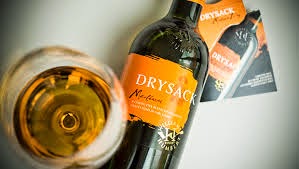
In modern times 'sack' is still given as a byword for medium dry sherries, like oloroso or amontillado. Indeed Williams & Humbert, one of the old English sherry houses, still label their amontillado as 'Dry Sack'; and this inviting and affordable drop served, slightly chilled, as many an aperitif for me in university days. We're reminded that unlike the polite one or two glasses before a meal that was drunk in the 19th and 20th centuries, prior to that our London Bankside revelers would have been on the higher proof sherry all night. But, best leave my encounters with casks of amontillado in Thames-side cellars for another time.

Williams & Humbert Dry Sack, still delicious